Generative Design for Jet Engine Turbines
15% Mass Reduction & Improved Flow
[ BUSINESS CONTEXT ]
A major aerospace engine manufacturer needed to reduce the overall mass of their next-gen turbofan to meet stringent new EU aviation emission targets and improve fuel efficiency for airlines.
[ PROJECT CHALLENGE ]
The fan blades undergo extreme centrifugal forces and bird-strike impact risks. Traditional machining could not remove enough internal mass without compromising the blade’s structural integrity and aerodynamic profile.
[ STRATEGIC SOLUTION ]
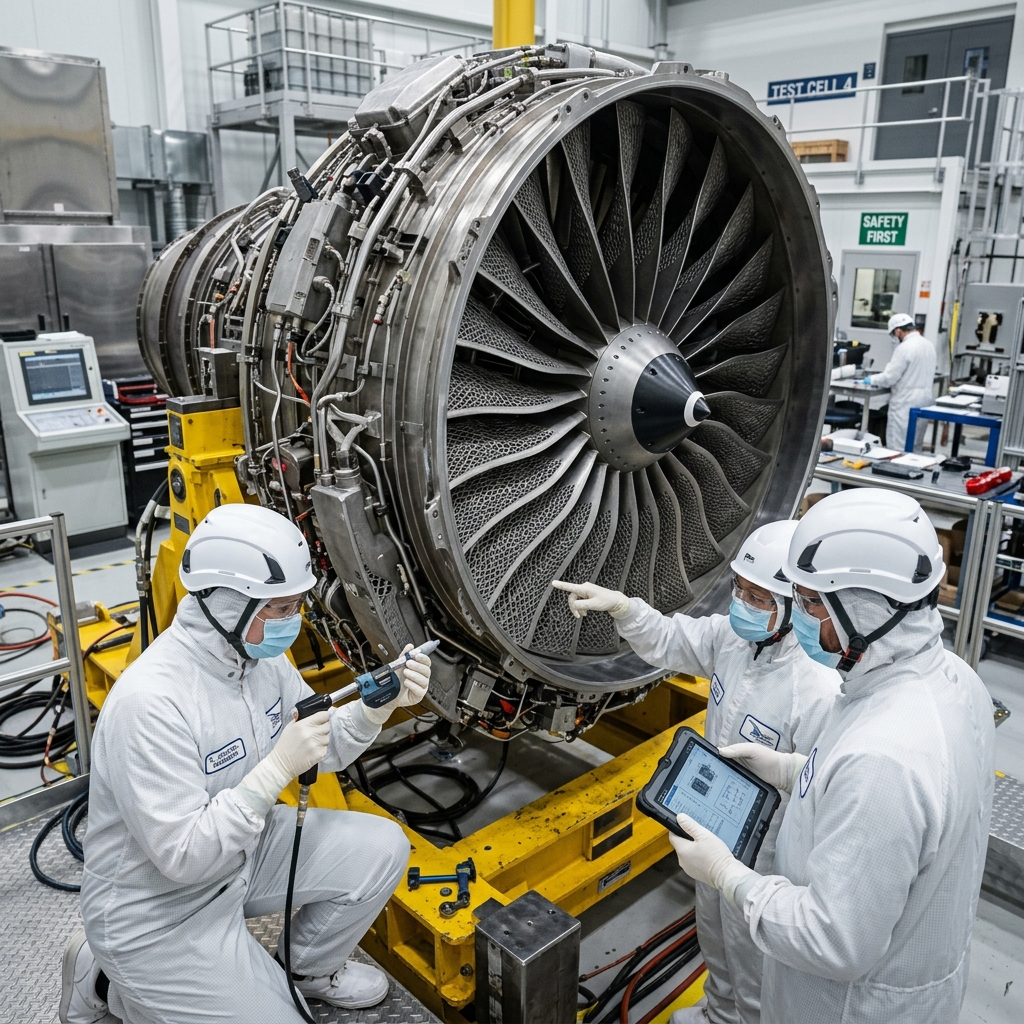
We employed generative design algorithms in Siemens NX to explore thousands of internal lattice structures. We constrained the AI to only output geometries that were viable for Direct Metal Laser Sintering (DMLS) 3D printing.
Engineering Methodology
Load Case Definition
Defined extreme boundary conditions including 10,000 RPM centrifugal forces and 4 lb bird strike simulations.
Generative Synthesis
Let the algorithm generate hollow internal lattice structures optimized for maximum stiffness-to-weight ratio.
Aerodynamic Validation
Ran CFD analysis to ensure the external airfoil shape maintained optimal thrust and boundary layer attachment.
Printability Analysis
Simulated the DMLS printing process to predict and mitigate thermal warping during manufacturing.
Quantified Engineering Impact
Internal lattice structures removed solid titanium while maintaining structural rigidity.
Lighter fan blades reduced the moment of inertia, requiring less energy to spool up the engine.
Generative design evaluated thousands of geometries that human engineers could never manually draft.
Despite the weight loss, the blades passed all simulated bird-strike and fatigue scenarios.