EV Battery Pack Structural & Thermal Validation
Zero Prototype Failures & 98.5% Correlation
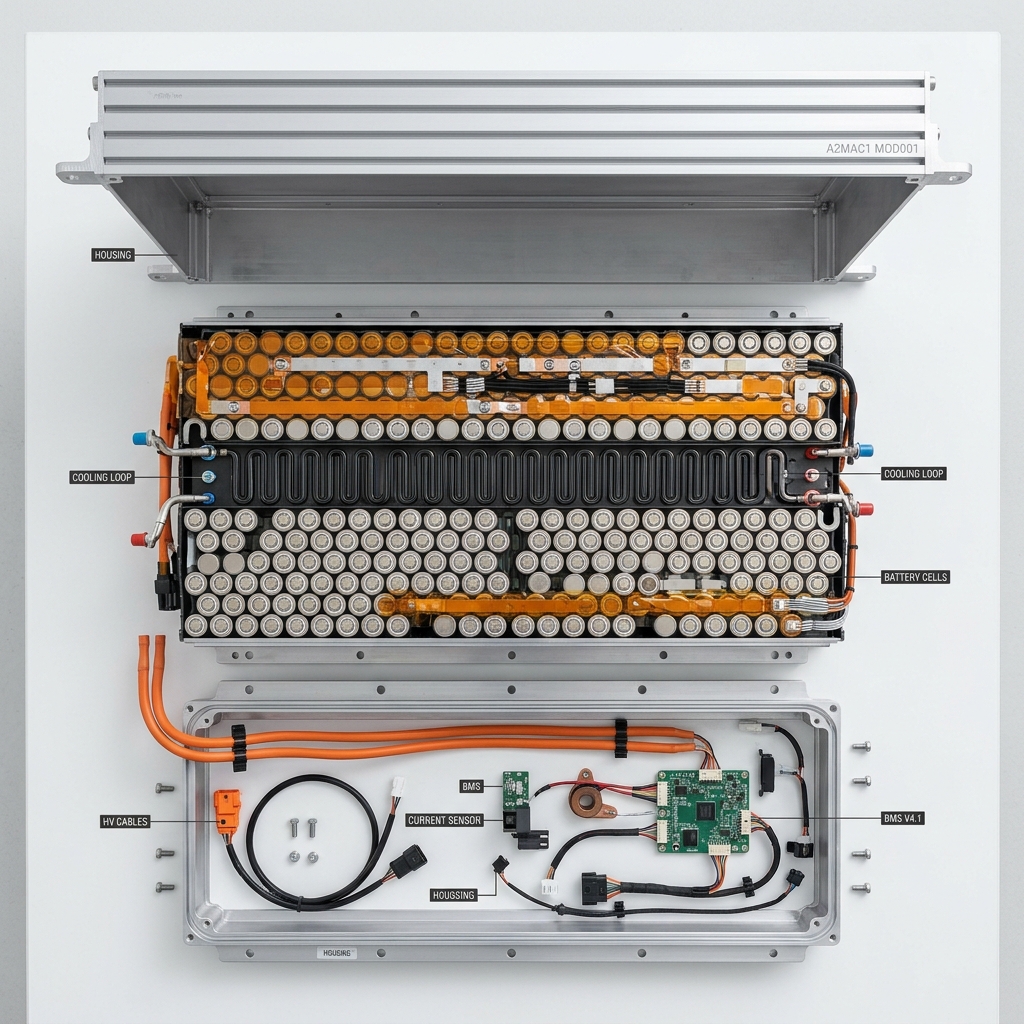
[ BUSINESS CONTEXT ]
An emerging EV manufacturer was developing their first platform with an aggressive 18-month timeline. Previous partner failures led to 4 months of delays, risking hundreds of millions in investor funding.
[ PROJECT CHALLENGE ]
The core problem was an inability to predict cell-level thermal runaway propagation under high-speed impact loads. A highly accurate simulation model was required to skip physical prototyping cycles.
[ STRATEGIC SOLUTION ]
We implemented a high-fidelity virtual validation methodology utilizing cell-level characterization testing to calibrate virtual twins, accurately representing real-world crash and thermal behavior.
Engineering Methodology
Explicit Dynamics (Crash)
Used Ansys LS-DYNA to simulate 12 distinct crash configurations.
Thermal Runaway Propagation
Developed a unified CFD-FEA model to predict heat transfer between cells.
Cooling Plate Optimization
Used parametric optimization to improve thermal uniformity by 30%.
Material Rate-Dependency
Calibrated rate-dependent material models from high-strain coupon testing.
Quantified Engineering Impact
Matched physical accelerometer data, giving confidence to skip 3 build cycles.
Balanced coolant distribution ensured cells remained within operational limits.
Removed redundant reinforcement after demonstrating safety margins exceeded 1.5x.
Delivered UN38.3 and Euro NCAP compliant dossiers requiring zero technical revisions.