AI Predictive Maintenance for Smart Factories
28% Reduction in Unplanned Downtime
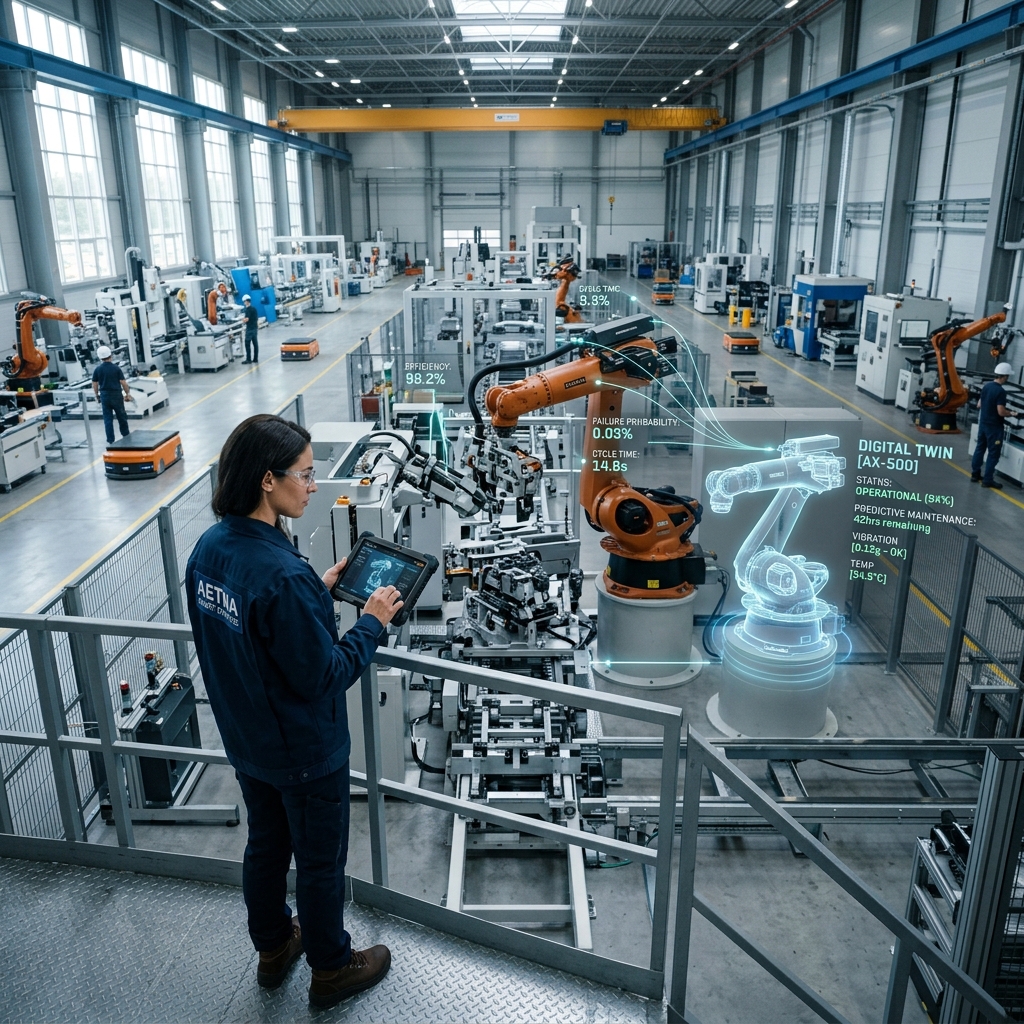
[ BUSINESS CONTEXT ]
An automotive OEM suffered from unpredictable robotic arm failures on their assembly line, causing cascading delays and millions of Euros in lost production yield per hour.
[ PROJECT CHALLENGE ]
Traditional preventative maintenance schedules resulted in either replacing parts too early (wasting money) or too late (causing downtime). They needed a predictive model capable of analyzing 50kHz vibration data to foresee failures weeks in advance.
[ STRATEGIC SOLUTION ]
We developed an end-to-end MLOps pipeline. Edge computing nodes pre-processed the high-frequency sensor data, and a centralized Deep Learning model identified the microscopic acoustic anomalies that precede mechanical failure.
Engineering Methodology
Edge Data Acquisition
Installed industrial IoT gateways to sample vibration and temperature sensors at 50kHz without overwhelming network bandwidth.
Feature Engineering
Applied Fast Fourier Transforms (FFT) to convert time-domain vibration data into frequency-domain signatures.
Model Training
Trained a Long Short-Term Memory (LSTM) neural network on 3 years of historical failure logs.
MLOps Deployment
Automated the retraining pipeline using Kubeflow to handle concept drift as machinery aged.
Quantified Engineering Impact
The AI successfully predicted 92% of mechanical failures at least 5 days before they occurred.
Shifted from scheduled replacement to condition-based maintenance, extending part lifespans.
Edge processing ensured immediate shutdown commands could be issued for critical anomalies.
High precision meant engineers were rarely dispatched for false alarms.