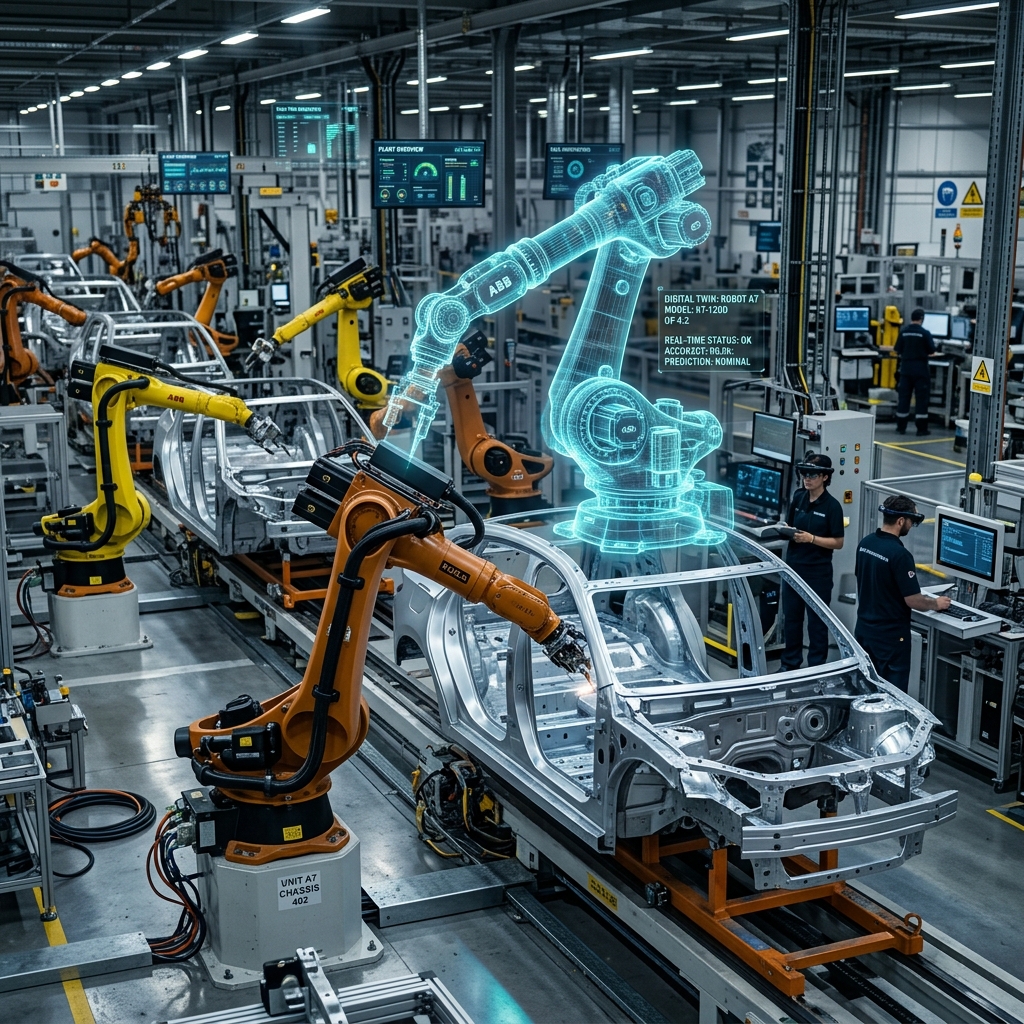
Smart Factory 3D Digital Twin Optimization
14% Throughput Increase via Simulation
[ BUSINESS CONTEXT ]
An automotive OEM was struggling to hit their production target of 60 vehicles per hour. Physical bottlenecks on the assembly line were costing them millions, but halting production to test new layouts was impossible.
[ PROJECT CHALLENGE ]
They needed a risk-free environment to simulate changes to robotic cell layouts, AGV (Automated Guided Vehicle) routing, and human-machine interaction times without disrupting ongoing operations.
[ STRATEGIC SOLUTION ]
We built a high-fidelity 3D digital twin of the factory using Siemens Plant Simulation. We connected the twin to real-time PLC data from the physical factory to ensure the simulation exactly mirrored real-world conditions.
Engineering Methodology
Laser Scanning
Created an exact 3D point-cloud of the factory floor to ensure accurate spatial constraints in the model.
Kinematic Modeling
Programmed the exact kinematic behaviors and cycle times of 150+ robotic arms into the simulation.
Data Integration
Hooked the simulation into the factory’s MES system via OPC-UA to feed it real-time operational data.
Scenario Testing
Simulated hundreds of layout changes and AGV traffic routing algorithms to find the optimal throughput.
Quantified Engineering Impact
Optimized AGV routing and rebalanced robotic cell cycle times eliminated the primary bottleneck.
All optimizations were proven in the virtual world before a single piece of physical machinery was moved.
Discovered inefficiencies in inventory staging areas, freeing up valuable factory real estate.
The increase in vehicle production paid for the entire digital twin project in less than 8 weeks.